

Introducing Human-AI Workflow Design
Learning how to design the future of work with AI.

Last week I wrote about the augmented organization. The vision of what becomes possible when humans and AI work collaboratively. This week I want to show you what that looks like in practice.
We’ve been developing something at Overlap for over a year. A design standard for human-AI workflows. A notation system. A visual language for designing and documenting workflows that combine human judgement with AI capability.
We call it Human-AI Workflow Design.
Before I go further, I want to make a distinction. Work is not a series of tasks a robot performs behind the scenes. Work is messier than that. Work is a team meeting about the project. External meetings with customers or clients. A one-on-one chat with your boss about the status update. The briefing that needs to go to the leadership team about next steps on this initiative. A facilitated session with external stakeholders using sticky notes and dialogue. Quiet solo work where you’re thinking about something, taking a bunch of inputs, deciding what to do with them. Shaping. Imagining. Thinking about strategy and approach. Reading documents, deciding what they mean to you, and then doing something with that.
Work is not just a set of instructions we can hand to a computer.
But there are things AI does extraordinarily well. AI holds more context than we can. AI is very good at structuring, at making meaning from a bunch of text and transcripts. It’s strong at drafting, at producing. When you know what you’re trying to produce, it’s extraordinary. It’s very good at creating instructions to perform a step, learning from how that work actually gets done between a human and AI in collaboration, and then updating those instructions to better capture how the work works.
Human-AI Workflow Design is about being thoughtful about where we deploy those capabilities to create the most value. And the most value in a workflow is not that it was automated. The most value is the quality of the output at the very end. After all of these steps, something emerges. The quality of those outputs, the quality of each handoff, that’s what actually matters. We need to think about effectiveness, not just efficiency.
The governance conversation around AI is maturing. Frameworks are emerging from regulators, from industry groups, from standards bodies. They’re increasingly asking organizations to define where human judgement is non-negotiable. To establish accountability chains. To document the role AI plays in decisions and ensure that role is appropriate, auditable, and improvable over time.
These are good principles. We should want these things.
But there’s no method for doing it.
What I’m seeing is people trying to cobble this together. I’ve been trying to cobble this together. And I’ve realized there are two different problems at play. There’s organizing your stuff, which you can do with a folder structure and some markdown files. Where you keep things matters. If you’ve got a prompt that executes a particular workflow, you need to be able to find it.
But organizing is different than documenting. And documenting is different than design.
Principles without method produce intent without capability. An organization can agree that human oversight matters, but then still have no shared language for describing where in a workflow that oversight actually happens. What governs the AI step that precedes it. What the output of that step becomes in the next part of the process.
Human-AI Workflow Design is a response to that gap.
The notation isn’t new from scratch. It extends something called IDEF0, a function modelling methodology that’s been around for decades. IDEF0 started as Structured Analysis and Design Technique in the 1970s, was adopted by the U.S. Air Force, and became an American federal standard for process modelling. It’s been adapted before for cooperative work, for service processes, for enterprise reengineering.
This adaptation is for the workflows that are now defining how organizations think, decide, and act.
What IDEF0 does that’s helpful in a human-AI world is treat a workflow as a set of activities. We are taking something and transforming it into something else. At a base level, we’re moving from activity to activity. Someone or something has to do the work of each activity. There are mechanisms that perform the work. A person. An AI tool. A piece of software. And there are controls that govern how the work gets done. Policies, procedures, regulations.
An arrow entering an activity box from the left is an input. An arrow leaving from the right is the output, which becomes the input for the next activity. Mechanisms are identified below. Controls enter from above.
And here’s what matters for AI: prompts are controls. A prompt governs how a step gets done. A prompt is not an input.
Let me make this concrete.
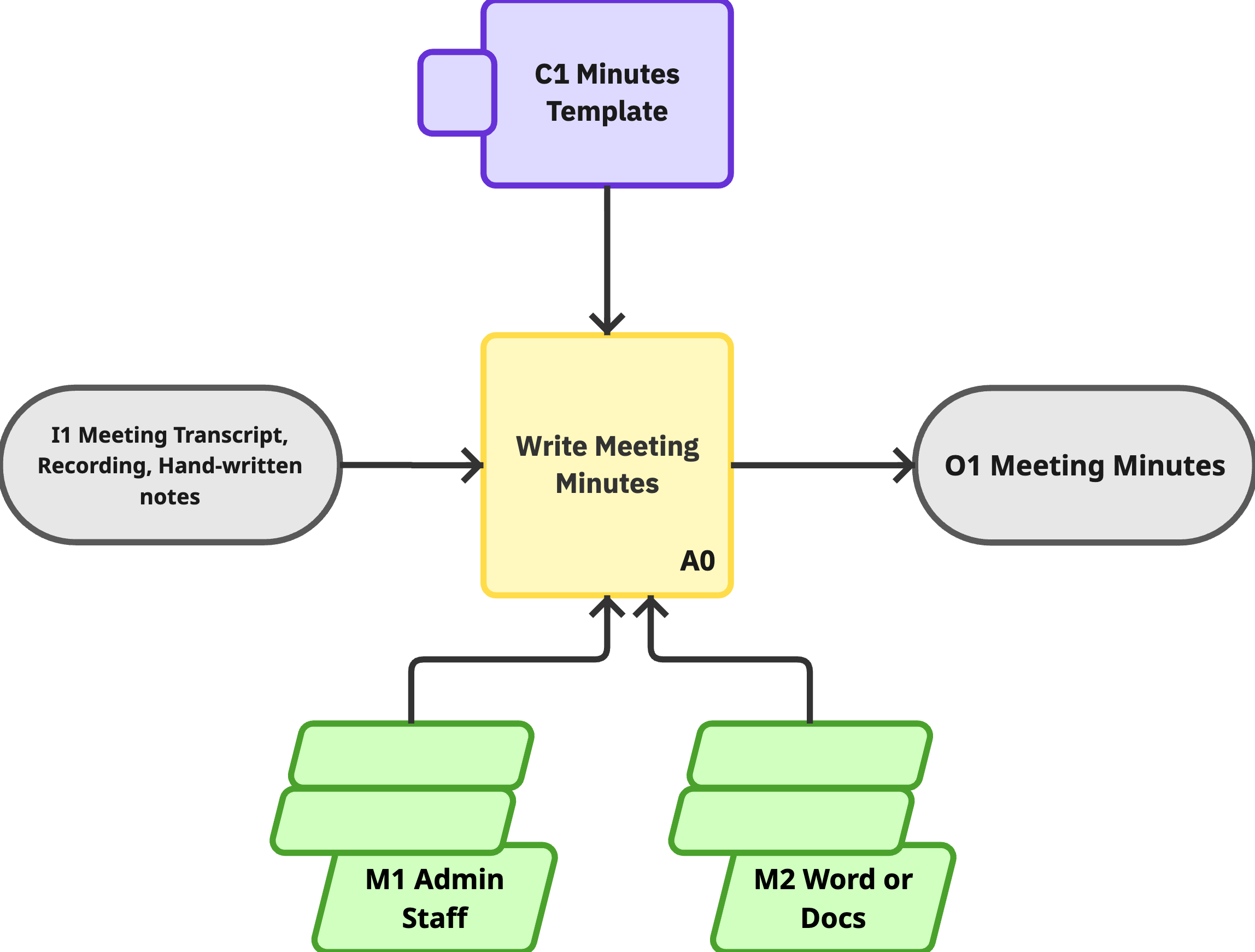
Think about running a meeting and producing minutes afterward. This is one of the most basic things we can do with AI.
Before AI, the input was a transcript, an audio file, or notes. The output was a draft of the meeting minutes. The mechanisms were a person and probably Microsoft Word. The control was a minutes template that defined what minutes look like in this organization.
Now add AI. The input is ideally a transcript of what people said. The output is still meeting minutes. The mechanisms now include an AI tool, whether that’s Copilot, ChatGPT, Claude, or Gemini. You still have a person. You still have Word or Google Docs. You still have the template, because the AI needs to know what structure you want. Otherwise it will choose, and you don’t want it to choose. You want to choose.
And now you’re also providing a prompt. As a control. That prompt might start as simple as: create meeting minutes using the provided transcript and applying the minutes template.
That will produce meeting minutes for you.
But here’s where it gets interesting. Through iteration, you offer corrections. The AI produced something, but it’s not quite right. “We never say it this way.” “We tend to position things like this.” You offer that feedback. You ask for the prompt to be updated. And the prompt evolves from “make meeting minutes” to “make meeting minutes like this.” Style, taste, judgement, expressed. The prompt becomes a control document that captures how the work actually gets done.
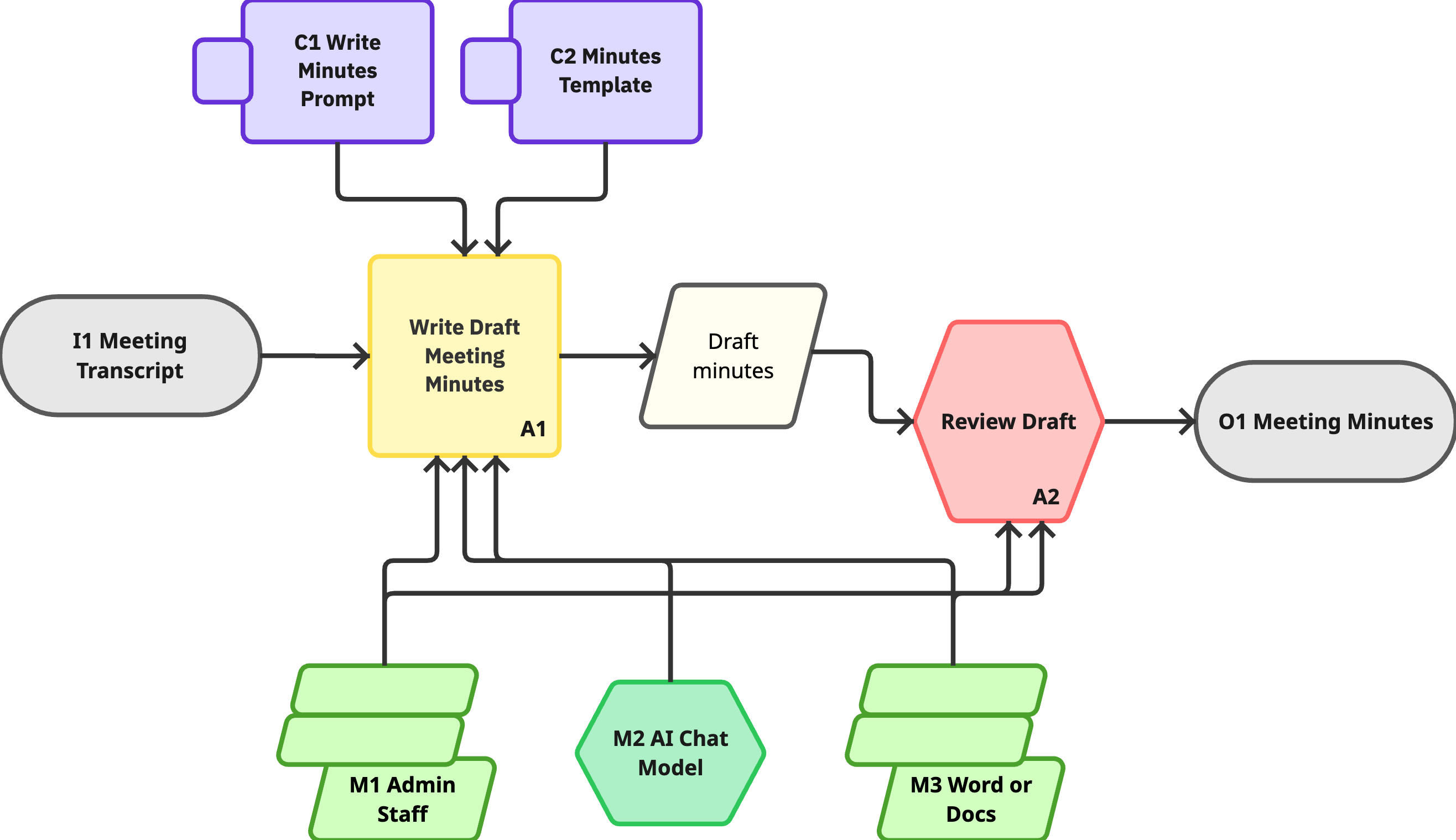
We add a human judgement checkpoint when AI is involved. Review the draft. Confirm it’s correct. Make adjustments. The steps for that human judgement checkpoint are outlined so the person doing it knows what they’re supposed to do. Is there a checklist of things to work through? What does human judgement in this step actually look like?
In an AI-native environment, you can work with the AI to figure that out. What should the review steps be? What are we checking for? You can have your AI coach you through the process when it’s documented.
This is a simple example. But it shows how the notation works. We have new mechanisms. Different AI tools, software with AI features built in. The notation gives us a way to identify them explicitly. Which tool? Which model? This creates transparency. And while we’re all figuring out how to do this, we actually need things explicitly identified. Because it is genuinely new.
We’ve written a design standard for Human-AI Workflow Design. The notation is all outlined. It’s a substantial document. And we’re releasing it under a Creative Commons Attribution 4.0 license. We want people to use it, adapt it, share it. Credit Overlap as the originating studio. But the point is to build a community around doing this. Improve the standard over time.
This is V1. We wanted to start because that’s what the moment requires. A rigorous starting point, not a finished product.
I’m using this in real work. I’ve built a tool that lets me describe a current workflow and get ideas about how to design human-AI collaboration into it. The tool makes suggestions about what could support the workflow. If the client is in a Microsoft-only environment, we’re only thinking about how to execute within the tools available to them.
But the bigger promise is not just applying AI to the way you work now. It’s using this way of thinking about designing with AI to imagine completely different ways of working and knowing how to build them. There are parts of this that could become technical and require an IT partner to support you. But a lot of this you can build on your own. You just don’t know how, because how would you know? I only know how because I’ve been doing it for over three years. This is how we get to the augmented organization. Completely rethinking work. Thinking about humans and AI working together collaboratively so we are getting the best of both.
This isn’t about pure automation. You could use the standard that way. Even in full automation, we still need decision logs. We still need to show where human-in-the-loop moments happen. The notation still answers those questions. But what we’re really trying to do is design for human-AI collaboration. There will be a human in the loop somewhere. There could be an automation that got us to a certain point, and now that information is being brought into an environment where the human is thinking about it and doing things and working with their AI. That’s different.
Human-AI Workflow Design is the basis of our Designing with AI workshop. You learn how the notation works. You learn to use the workflow design tool. You leave with a new skill set to design human-AI workflows consistently, using a methodology that answers the questions governance frameworks are asking. It provides a way to do the documentation. It gives you a way to design workflows that don’t rely on the AI tools remaining constant, because they get new capabilities all the time. You are being invited into a space that is constantly evolving and shifting along with the whole industry, so that we are always designing with the tools people actually have access to, ways of working that can actually work.
Over the coming weeks, we’re going to release the whole standard. It’s a substantial document. But I’m going to continue previewing it here on Substack in a more digestible form.
This is what we’ve built. More soon!